
Keyword: Stage Lighting Grid System
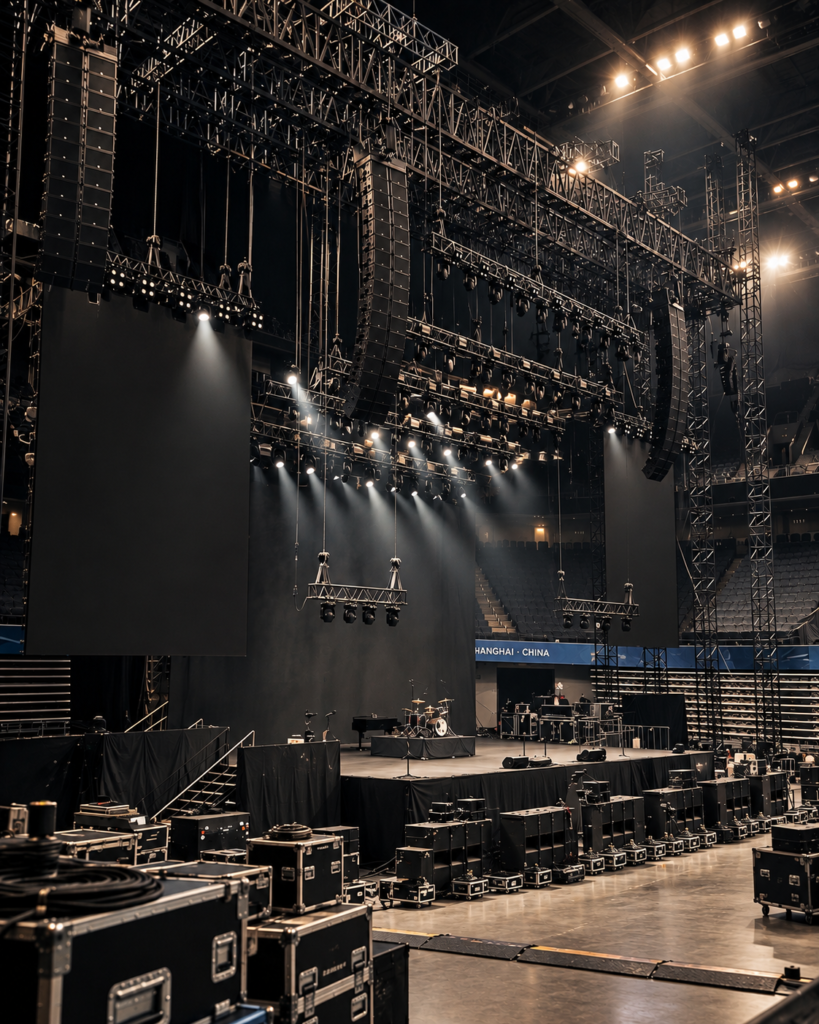
(Overhead stage lighting and rigging infrastructure in a professional live-event venue)
A stage lighting grid system is an important part of the technical infrastructure in theatres, performing arts centres, universities, auditoriums, concert venues and multipurpose event spaces. Installed above the stage, a lighting grid provides a structured framework for positioning and supporting lighting equipment while giving technicians practical access for installation, adjustment and maintenance.
In professional live-event environments, overhead lighting and rigging systems can become a substantial part of the venue’s technical infrastructure, as shown in the photograph above. The exact configuration varies from venue to venue, ranging from fixed lighting grids and bars to larger suspended truss and rigging systems.
A stage lighting grid system is an important part of the technical infrastructure in theatres, performing arts centres, universities, auditoriums, concert venues and multipurpose event spaces. Installed above the stage, a lighting grid provides a structured framework for positioning and supporting lighting equipment while giving technicians practical access for installation, adjustment and maintenance.
Modern productions can require dozens or even hundreds of lighting fixtures, depending on the size and purpose of the venue. These fixtures need reliable mounting positions, suitable cable management and sufficient access for technical teams. A properly designed stage lighting grid system helps bring these requirements together into one coordinated overhead system.
For architects, venue operators, stage consultants and project engineers, understanding the role of a lighting grid is an important part of planning a functional and adaptable performance space.
What Is a Stage Lighting Grid System?
A stage lighting grid system is an overhead structural framework designed to provide designated positions for mounting and servicing stage lighting equipment.
Depending on the venue, the grid may incorporate structural steel members, trusses, lighting bars, walkways, access platforms, mounting points and cable-support systems. It may also be designed as part of a larger stage rigging and automation system.
A stage lighting grid system can provide mounting locations for equipment such as:
- LED stage lighting fixtures
- Profile and ellipsoidal spotlights
- Fresnels and wash lights
- Moving-head fixtures
- Lighting accessories
- Special effects equipment
- Technical cables and distribution equipment
The configuration varies according to the architecture of the venue, stage dimensions, required equipment, structural conditions and applicable regulations.
A stage lighting grid system should therefore be considered as part of the venue’s overall technical infrastructure rather than simply as a place to hang lights.
Why Do Venues Need a Lighting Grid?
Lighting designers need to illuminate performers, scenery and architectural features from different directions. A single overhead lighting bar cannot provide the same flexibility as a larger grid with multiple mounting positions.
A well-planned stage lighting grid system can provide:
Flexible lighting positions
Multiple mounting locations allow lighting designers to create different lighting angles and adapt the system to different productions.
Efficient maintenance access
Lighting fixtures require periodic inspection, adjustment, cleaning, replacement and servicing. A suitable access arrangement can make these activities safer and more practical for trained technicians.
Better use of stage space
By locating technical equipment overhead, the venue can keep valuable stage-floor space available for performers, scenery, vehicles and other production equipment.
Integration with other technical systems
A stage lighting grid system may need to operate alongside scenery bars / stage flying bar system, curtain systems, speakers, projection equipment, stage machinery(like rotating platform and stage lift ) and other rigging systems. Early coordination helps prevent conflicts between these systems.
Main Components of a Stage Lighting Grid System
There is no single standard configuration for every venue. However, several components are commonly considered when developing a lighting grid.
1. Structural Grid
The structural grid forms the primary framework. Depending on the project, this may use structural steel sections, tubular members, trusses or custom-fabricated components.
The structure needs to be engineered according to its intended loads and the way those loads are transferred into the supporting building structure.
2. Lighting Mounting Points
Dedicated mounting points allow lighting fixtures to be installed at predetermined positions.
The mounting arrangement should consider the equipment weight, fixture orientation, access, cable routing and appropriate primary and secondary attachment methods.
ESTA’s current ANSI E1.53-2025 addresses overhead mounting of luminaires, lighting accessories and other portable devices, including requirements for primary and secondary mounting devices. (ESTA)
3. Access Walkways
Larger lighting grids may incorporate walkways or working platforms so trained technicians can reach equipment for inspection and maintenance.
Access routes, flooring, guarding, fall protection and entry points should be incorporated into the design rather than treated as additions after the structural system has been completed.
4. Cable Management
A modern stage lighting grid system can require substantial quantities of power and data cabling.
Cable-support routes should be planned together with the structural grid to help keep cables organised, protected and accessible without interfering with lighting fixtures, moving equipment or maintenance routes.
5. Integration with Stage Rigging
The overhead space above a stage is often shared by several technical systems.
Lighting fixtures may be installed close to scenery bars, curtain systems, projection equipment, audio systems and other suspended equipment.
This makes coordination essential. A stage lighting grid system should be designed with the complete stage environment in mind.
Stage Lighting Grid vs. Lighting Bar
The terms lighting grid and lighting bar are sometimes used interchangeably, but they describe different types of infrastructure.
A lighting bar is generally a linear mounting position for lighting equipment. It may be fixed in place or incorporated into a manually or electrically operated flying system.
A lighting grid is a larger overhead framework that can provide multiple mounting locations across an area of the stage.
For a smaller venue with straightforward production requirements, a series of lighting bars may provide sufficient flexibility. Larger theatres and multipurpose venues may benefit from a more comprehensive grid arrangement.
The appropriate solution depends on the venue’s production requirements rather than simply the size of the stage.
Stage Lighting Grid Systems for Different Venues
Lighting grids can be designed for many different applications.
Theatres
Traditional theatres often require numerous lighting positions and close integration with scenery, curtains and flying systems.
A grid can provide additional flexibility for productions with changing lighting requirements.
Universities and Performing Arts Centres
University venues often host theatre, dance, concerts, lectures, graduation ceremonies and student productions.
A flexible lighting infrastructure can therefore be valuable because the same space may need to support very different production formats.
Concert and Live Entertainment Venues
Concert venues can require substantial quantities of lighting equipment and frequently combine permanent infrastructure with temporary production rigging.
The grid may therefore form part of a broader technical rigging strategy.
Convention and Exhibition Centres
Large multipurpose venues may need overhead infrastructure capable of supporting changing event configurations.
The design needs to consider not only lighting but also other technical equipment and the operational requirements of the space.
Multipurpose Auditoriums
Auditoriums used for performances, presentations and community events can benefit from flexible overhead lighting positions without requiring a dedicated theatre configuration.
Safety and Engineering Considerations
Because lighting grids are overhead structures, safety needs to be considered throughout the design, fabrication, installation and operational stages.
Industry organisations provide guidance covering entertainment rigging and overhead equipment. PLASA’s rigging and engineering resources include guidance from the National Rigging Advisory Group and the International Code of Practice for Entertainment Rigging (ICOPER). These resources cover areas including planning, engineering, equipment selection and onsite rigging operations. (PLASA)
ESTA’s Technical Standards Program also publishes entertainment-industry standards covering subjects such as overhead mounting and permanent rigging support points. Its current published list includes ANSI E1.56-2026, which addresses the design, fabrication, installation, inspection and documentation of permanent rigging support points. (ESTA)
Local building regulations, electrical requirements, occupational safety rules and other applicable standards must also be considered for each project.
A stage lighting grid system should therefore be designed for its actual intended use rather than relying on a generic load assumption.
Planning a Stage Lighting Grid System for a New Venue
The stage lighting grid design process should begin with the intended use of the venue.
Important considerations can include:
- Stage dimensions
- Available overhead height
- Lighting positions
- Types and quantities of fixtures
- Equipment weights
- Structural loading
- Building structure
- Access requirements
- Cable routing
- Electrical and data distribution
- Interaction with scenery
- Stage automation
- Rigging systems
- Maintenance requirements
- Future production requirements
- Applicable local regulations and standards
One of the most important principles is to consider the lighting grid and supporting building structure as one engineering system.
The grid itself may be strong enough for a particular load, but the connections and building structure must also be capable of safely transferring those loads.
Custom Stage Lighting Grid Solutions
Not every venue can accommodate a standard lighting-grid arrangement.
Existing buildings may have unusual structural layouts, restricted headroom, architectural features or limited access. New venues may have specific production requirements that call for a custom configuration.
Custom mechanical fabrication can provide solutions for unusual dimensions, mounting arrangements and integration requirements.
Conclusion
A stage lighting grid system provides much more than overhead mounting space for lighting fixtures. It can form an important part of the venue’s technical infrastructure, connecting structural support, equipment mounting, access, cable management and stage rigging requirements.
The right solution depends on the venue, its architecture and the productions it is expected to support.
For theatres, universities, concert venues, convention centres and multipurpose auditoriums, early engineering coordination can help create a lighting infrastructure that is flexible, maintainable and suitable for long-term use.
A carefully designed stage lighting grid system can also provide a foundation for future upgrades as lighting technology and production requirements evolve.
At Magic Rigs, we work with contractors and project partners to turn project requirements and specifications into practical, buildable solutions. From engineering and custom fabrication to manufacturing, we provide integrated lighting grid and stage automation systems tailored to each project.
Have a project in mind? Get in touch with our team to discuss your requirements.