
Keyword: stage lift, stage automation, theatre projects
Modern theatres and performance venues are expected to do much more than simply provide a flat stage. A single venue may need to accommodate theatre productions, concerts, conferences, school performances, exhibitions and other live events, each requiring a different stage configuration.
This is where a stage lift system can provide a significant advantage.
A stage lift is a mechanically engineered platform designed to move vertically, allowing part or all of a stage to be raised or lowered. Depending on the design and application, stage lifts can be used to create different stage levels, move equipment and scenery, form orchestra pits, provide access between stage levels, or transform the stage configuration between performances.
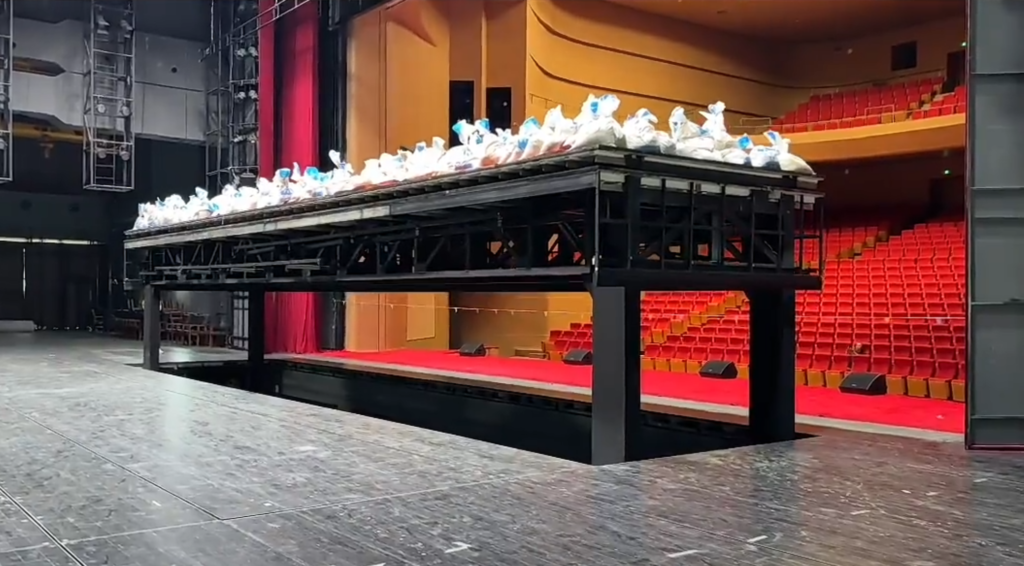
The photograph above illustrates the scale and structural complexity that can be involved in a modern stage lifting platform. The large raised platform is supported by a substantial steel structure, with the auditorium visible behind it. While the lifting mechanism itself is not visible in the photograph, the structure demonstrates how a stage lift must combine load-bearing capacity, mechanical movement, stability and precise positioning.
There are Different Types of Stage Lifts. The choice between different lifting technologies should always be based on the actual engineering requirements rather than simply selecting a standard mechanism.
Engineering a Stage Lift for Real-World Theatre Conditions
A stage lift is not simply a platform with a motor underneath it.
The system must be engineered around the complete operating environment.
A theatre stage may need to support performers, scenery, musical instruments, technical equipment and other loads. The platform must therefore be designed for the required working load and load distribution, while maintaining stability throughout its movement.
The available pit depth is another important consideration. A lift that needs to travel a significant vertical distance may require substantial space below the stage.
Other important engineering factors include:
- Platform dimensions
- Maximum lifting capacity
- Vertical travel
- Lifting and lowering speed
- Structural deflection
- Platform stability
- Guide systems
- Mechanical synchronisation
- Drive and power requirements
- Safety systems
- Access and maintenance
- Noise and vibration
- Integration with the venue’s control system
These factors need to be considered together during the design stage.
Stage Lifts and Stage Automation
The real value of a stage lift becomes even greater when it forms part of an integrated stage automation system.
Modern theatre automation can allow operators to control multiple pieces of stage machinery from a central interface. Stage lifts, flying systems, curtain systems, turntables and other equipment can potentially be coordinated to create complex stage transformations.
For example, a production may require a platform to move from one stage level to another at a carefully controlled speed and stop at an accurately defined position. Repeatability is particularly important when the same movement needs to be performed numerous times during a production.
Automation therefore goes beyond simply making a platform move. It is about making the movement controlled, repeatable and integrated with the wider stage environment.
Why Custom Stage Lift Design Matters
Every theatre is different.
The dimensions of the stage, available pit depth, structural conditions, required load capacity and intended use can vary considerably from one venue to another. For this reason, a stage lift should not necessarily be treated as an off-the-shelf product.
A custom-engineered system can be designed around the actual requirements of the venue.
The structure shown in the photograph is a good example of why engineering matters. A large stage platform must provide a rigid and stable working surface while accommodating the mechanical and structural requirements underneath it.
The final design may involve structural steelwork, lifting mechanisms, guides, drive systems, limit switches, sensors and control equipment working together as one system.
Safety Is Fundamental
Because stage lifts move substantial structures and loads, safety must be considered from the beginning of the engineering process. EN 17206 provides safety requirements and inspection principles for machinery used in stages and other production areas. For projects in the UK and other markets where relevant standards apply, stage machinery should be designed and assessed in accordance with the applicable safety requirements. BS EN 17206-1 provides requirements covering machinery for stages and other production areas.
A properly designed stage lifting system should incorporate appropriate mechanical and electrical safety measures, including controlled movement, position monitoring, emergency stopping and protection against unintended operation.
The exact safety architecture will depend on the application, jurisdiction and applicable standards.
Safety should therefore be incorporated into the design, manufacture, installation, commissioning and operation of the system—not added as an afterthought.
Choosing the Right Stage Lift
When planning a new theatre stage lift, venue operators and project engineers should first define what the system needs to achieve.
Important questions include:
- How large is the platform?
- What is the maximum working load?
- How far does the platform need to travel?
- How frequently will it operate?
- What movement speed is required?
- How much space is available below the stage?
- Does the platform need to operate independently or as part of a larger system?
- What level of positioning accuracy is required?
- How will the lift be controlled?
- What maintenance and access requirements need to be considered?
Answering these questions at the beginning of a project helps engineers determine the most appropriate lifting technology and system architecture.
Building More Flexible Performance Spaces
Theatre technology continues to evolve, and stage lifts are an important part of that evolution.
A well-designed stage lift system can transform a conventional fixed stage into a much more adaptable performance environment. It can help venues accommodate different productions, improve backstage logistics and create new possibilities for stage design.
The photograph demonstrates the physical scale of this type of engineering: a substantial movable platform integrated into a professional theatre environment. Behind the machinery is ultimately a simple objective—to give performers and production teams more ways to use the stage.
Whether the application requires a hydraulic lift, screw jack system, scissor lift or another customised mechanical solution, the most important consideration is that the complete system is engineered around the venue’s specific requirements.
For theatres, universities, concert halls and other performance spaces, a professionally designed stage lift can therefore be much more than a lifting platform. It can become an integral part of the venue’s stage automation and production infrastructure, providing reliable and flexible movement for years of operation.
📢 Need a Custom Stage Lift System?
Every venue has different structural, load and operational requirements. Magic Rigs provides engineering-led solutions for stage automation and mechanical systems, with stage lift designs developed around the specific requirements of each project.
Contact us to discuss your stage lift application, lifting capacity, travel requirements and stage configuration.